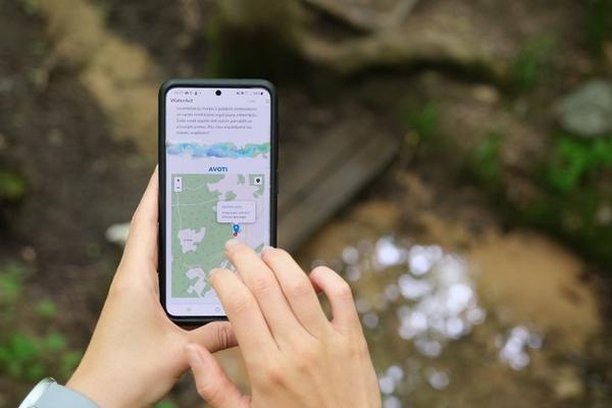
Dji Mansa, "Water Masters in Bambara"
from 12/06/2024 until 29/07/2026
Dji Mansa (“Water Masters”) is a citizen science
initiative implemented in Mali and Niger that aims to strengthen water
governance through the co-production of knowledge between local communities,
researchers, and public institutions.
The project is led by AFR’EAU in partnership with national
water authorities, academic institutions, and youth networks. It operates in
riverine communities along the Niger River, where water quality degradation
directly affects livelihoods, health, and ecosystems.
Dji Mansa combines community-based
observations with scientific water quality monitoring. Local
participants, referred to as “citizen scientists”, are trained to document
environmental changes using scientific tools (measuring parameters
such as turbidity, dissolved oxygen, nitrate, and pH), and their observations
and local knowledge were documented.
This dual approach allows the project to bridge
scientific and traditional knowledge systems, making water quality data more
contextualized, accessible, and actionable.
The methodology relies on participatory tools such as focus
group discussions, and community mapping. Data is not only collected but
also discussed and validated with communities, ensuring that it reflects
lived realities.
A key feature of Dji Mansa is its focus
on institutional engagement. The project works closely with national and
local authorities to:
- build
trust in citizen-generated data,
- create
dialogue spaces between communities and decision-makers,
- and
explore pathways for integrating citizen science into formal water
governance systems.
Beyond data collection, Dji Mansa contributes
to awareness raising, advocacy, and capacity building, including youth
engagement and training of early-career researchers.
By positioning communities as
knowledge holders and active contributors, Dji Mansa seeks to redefine how
environmental monitoring is conducted in the region toward inclusive,
participatory, and governance-oriented citizen science.
Aim
The overall objective of Dji Mansa is to strengthen
inclusive and evidence-based water governance through citizen science
approaches that integrate local and scientific knowledge systems.
The project pursues the following specific objectives:
1. Generate contextualized water quality data
To produce reliable and locally grounded data on water quality in riverine
communities by combining scientific measurements with community-based
environmental observations.
2. Empower communities as active contributors to water
monitoring
To build the capacities of local populations (particularly youth and
marginalized groups) to participate in data collection, and interpretation.
3. Bridge knowledge systems
To create synergies between traditional/local knowledge and scientific
methodologies, ensuring that environmental monitoring reflects both lived
experiences and technical evidence.
4. Strengthen dialogue between communities and
institutions
To facilitate structured exchanges between citizen scientists, researchers, and
public authorities, enabling mutual understanding and more responsive
governance mechanisms.
5. Increase institutional recognition of citizen science
To demonstrate the value of citizen-generated data in informing policies and
practices, and to support its gradual integration into formal water management
frameworks.
6. Support advocacy and awareness on water quality issues
To use project findings to raise awareness on pollution, ecosystem degradation,
and public health risks, while encouraging concrete actions from stakeholders.
7. Build local and regional capacity for participatory
monitoring
To develop skills among students, young professionals, and institutions in
citizen science methodologies, contributing to long-term sustainability and
scalability.
Through these objectives, Dji Mansa contributes to
advancing inclusive governance, environmental justice, and community
resilience, while positioning citizen science as a credible and complementary
approach to conventional water monitoring systems.
Participation & Audience
Target group: Local riverine communities in Mali (Bozo) and Niger (Niamey)
Number of participants: 150
Duration of involvement: 6 months
How to participate
People can get involved in Dji Mansa through multiple entry
points, depending on their background, interest, and level of engagement.
At the community level, local residents (particularly youth,
women, and river-dependent groups) can participate as citizen scientists. They
are engaged through awareness sessions and trained to carry out water quality
observations and measurements, as well as to share their knowledge and
perceptions of environmental changes. Participation is designed to be inclusive
and accessible, including for non-literate participants through adapted
facilitation methods.
Students and early-career professionals can get involved
through research placements, internships, and field activities, contributing to
data collection, analysis, and the development of locally relevant solutions.
The project collaborates closely with academic institutions to support applied
research and capacity building.
Institutions, including public authorities and technical
agencies, can engage by collaborating on monitoring activities, providing
technical expertise, and participating in dialogue platforms that connect
communities with decision-makers. This helps ensure that citizen-generated
insights are aligned with and contribute to existing governance frameworks.
Civil society organizations and youth networks can join as implementation
or outreach partners, supporting community mobilization, awareness raising, and
scaling of the approach in new locations.
More broadly, stakeholders can engage with Dji Mansa through
knowledge-sharing events, workshops, and dissemination activities, where
findings are presented and discussed to inform action and policy.
The project is designed as an
open and evolving initiative, and we welcome collaboration with partners
interested in citizen science, water governance, and community-based
environmental monitoring, both at national and international levels.
Insights and Highlights
• Implementation of community-based water monitoring: Established citizen science activities across multiple sites in Mali and Niger, engaging over 150 community members in water quality observation and testing (turbidity, dissolved oxygen, nitrate, pH). • Scientific knowledge production: A manuscript based on the project findings has been submitted to a peer-reviewed journal, contributing to the scientific recognition of citizen science approaches in water quality monitoring. • Dissemination and international visibility: Produced and screened a documentary film at conferences and events in the Netherlands, Mali, Niger, Spain, and the United States. Contributed to a UN-Water policy brief, an IWA publication, and participated in podcasts to share insights and lessons learned. • Institutional engagement and policy uptake: Initiated advocacy efforts with national stakeholders, leading to ongoing discussions to develop a citizen science pilot with the National Directorate of Hydraulics in Mali. • Capacity building and academic contribution: Supported 1 completed Master’s thesis and secured 5 internships for graduate students, strengthening local research capacity and engagement in citizen science. • Advocacy and multi-stakeholder dialogue: Organized workshops bringing together local and national decision-makers to discuss water quality challenges and the role of citizen science in governance.
• Institutional sensitivity around citizen-generated data: Some public authorities expressed concerns regarding data ownership, credibility, and public dissemination. The project prioritized early and continuous engagement with national and local institutions, involving technical experts (e.g. from the water utility) in data collection and validation to build trust and legitimacy. • Balancing scientific rigor with community participation: Ensuring reliable data while working with non-expert participants required careful design. We implemented standardized protocols, hands-on training, and expert supervision during measurements, ensuring data quality while maintaining inclusive participation. • Limited involvement of communities in data interpretation: While communities actively contributed to data collection and observations, their role in interpreting scientific results remained limited. The project plans to strengthen community involvement in interpretation and decision-making in future phases. • Logistical and operational constraints in field settings: Working across multiple sites with varying accessibility and infrastructure posed coordination challenges. The project relied on local facilitators, flexible planning, and partnerships with local organizations to ensure continuity and adaptability of activities. • Managing expectations of communities: Participation raised expectations for immediate solutions to water quality issues. The project facilitated transparent communication, emphasizing the project’s scope while linking findings to advocacy and dialogue with decision-makers. • Political and contextual risks related to data sharing: Open dissemination of water quality data can be sensitive and potentially undermine institutional collaboration. The project adopted a context-sensitive data management approach, prioritizing local ownership and controlled sharing mechanisms aligned with national stakeholders.
What makes Dji Mansa special is its deliberate effort to bridge scientific approaches with local, experience-based knowledge, in a way that is both rigorous and grounded in community realities. Rather than treating communities as data collectors, the project recognizes them as knowledge holders and builds a process where their observations meaningfully complement scientific measurements. Another distinctive aspect is the project’s focus on institutional engagement from the outset. By working closely with national authorities and technical actors, Dji Mansa goes beyond awareness-raising and contributes to positioning citizen science as a credible and relevant approach for water governance in contexts where it is still emerging. We are particularly proud of having built trust across very different stakeholder groups and of demonstrating that citizen-generated data can serve as a basis for dialogue. The project has also succeeded in achieving strong visibility, with outputs ranging from a scientific manuscript submission to international dissemination through a documentary, policy contributions at the United Nations, and conferences. A key lesson from Dji Mansa is that context matters deeply in citizen science. Approaches to data sharing, participation, and engagement must be adapted to political, institutional, and social realities. Building trust with authorities and communities requires time, transparency, and flexibility. Overall, Dji Mansa demonstrates that citizen science can be both scientifically credible and socially embedded, and that its impact depends as much on relationships and trust as on data itself.
About funding
Funding bodies: IHE delft
Funding program: water development partnership programme
Coordinator
AFR'EAU
Non-governmental
Water type
Keywords
Science Topics
Tags
Difficulty Level
Participation tasks
Location
Contact
Similar projects

PreserVamos
No organization
13/11/2025
CrowdWater
27/10/2025
Plastic Pirates - Go Europe!
No organization
01/10/2025
Science In and with Society: reducing emissions of TExtile Microplastics in the NetherLands (SISTEM-NL)
27/11/2025
Freshwater Watch Parma
05/12/2025